how to tell from p/e ratio what stock is less riskier to buy
What is the Toll Earnings Ratio?
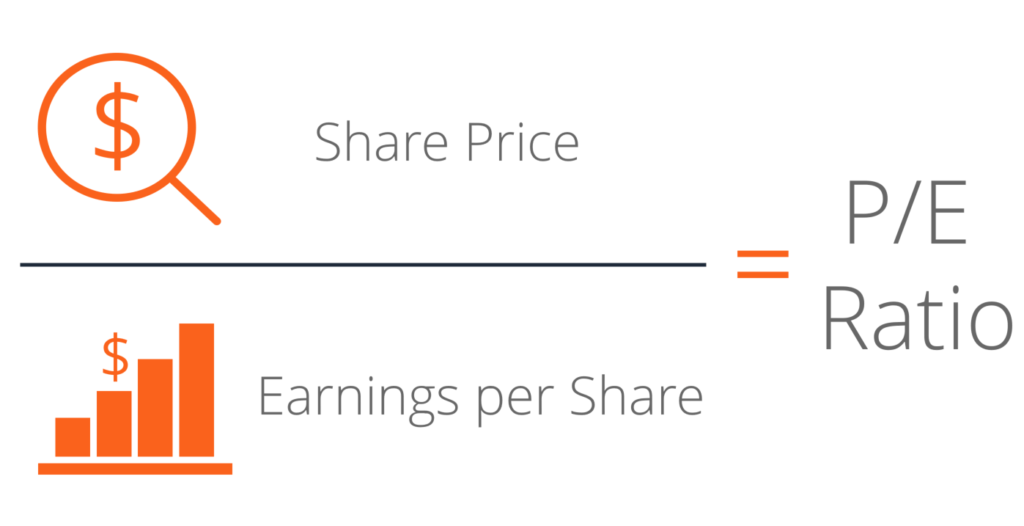
The Cost Earnings Ratio (P/E Ratio) is the relationship between a company's stock price and earnings per share (EPS) . It is a popular ratio that gives investors a better sense of the value of the company. The P/E ratio shows the expectations of the market and is the toll you must pay per unit of measurement of current earnings (or future earnings, as the case may be).
Earnings are important when valuing a company's stock because investors want to know how profitable a company is and howprofitable it will be in the future. Furthermore, if the company doesn't abound and the electric current level of earnings remains constant, the P/Eastward can exist interpreted every bit the number of years it will accept for the company to pay dorsum the amount paid for each share.
Epitome: CFI's Fiscal Analysis Courses .
P/E Ratio in Use
Looking at the P/E of a stock tells you very little nigh it if it's not compared to the company'southward historical P/E or the competitor'south P/E from the same industry. It'due south not easy to conclude whether a stock with a P/E of 10x is a deal or a P/E of 50x is expensive without performing whatsoever comparisons.
The dazzler of the P/Due east ratio is that information technology standardizes stocks of different prices and earnings levels.
The P/E is too called an earnings multiple. There are two types of P/E: trailing and frontward. The former is based on previous periods of earnings per share, while a leading or forrard P/E ratio is when EPS calculations are based on futurity estimates, which predicted numbers (often provided by management orequity research analysts ).
Toll Earnings Ratio Formula
P/E = Stock Cost Per Share / Earnings Per Share
or
P/E = Market Capitalization / Total Internet Earnings
or
Justified P/Due east = Dividend Payout Ratio / R – G
where;
R = Required Charge per unit of Return
G = Sustainable Growth Rate
P/Due east Ratio Formula Explanation
The bones P/E formula takes the current stock price and EPS to find the current P/E. EPS is plant by taking earnings from the last twelve months divided by the weighted average shares outstanding . Earnings tin can exist normalized for unusual or ane-off items that can touch earnings abnormally. Acquire more about normalized EPS .
The justified P/E ratio is used to detect the P/E ratio that an investorshould be paying for, based on the companies dividend and memory policy, growth rate, and the investor'southward required rate of return . Comparing justified P/E to basic P/E is a common stock valuation method.
Why Utilise the Toll Earnings Ratio?
Investors want to purchase financially sound companies that offer a good return on investment (ROI) . Amidst the many ratios, the P/E is function of the research process for selecting stocks because we tin figure out whether we are paying a fair toll.
Like companies within the same manufacture are grouped together for comparison, regardless of the varying stock prices. Moreover, information technology's quick and piece of cake to employ when we're trying to value a visitor using earnings. When a high or a low P/E is found, we can quickly assess what kind of stock or company we are dealing with.
Loftier P/East
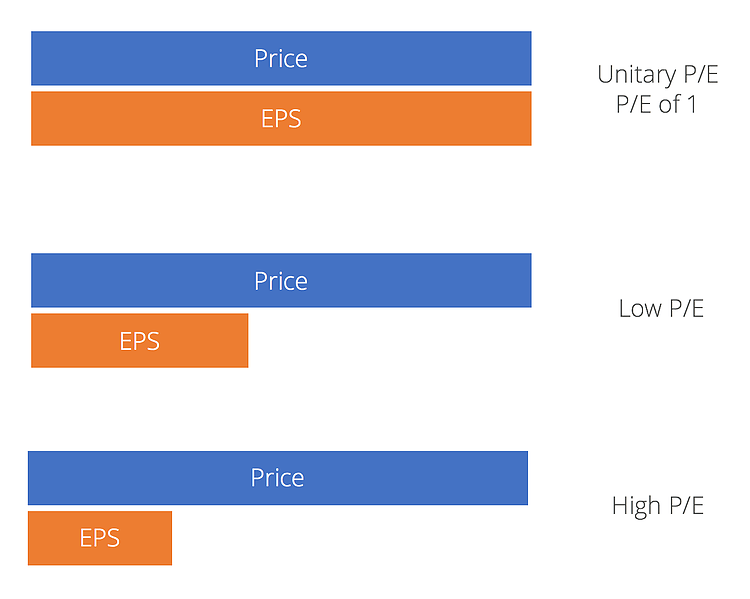
Companies with a high Price Earnings Ratio are often considered to be growth stocks. This indicates a positive future functioning, and investors have higher expectations for future earnings growth and are willing to pay more for them.
The downside to this is that growth stocks are often higher in volatility, and this puts a lot of pressure level on companies to do more to justify their higher valuation. For this reason, investing in growth stocks volition more likely be seen as a risky investment. Stocks with high P/E ratios can as well be considered overvalued.
Depression P/Due east
Companies with a low Price Earnings Ratio are oftentimes considered to exist value stocks. It means they are undervalued because their stock prices trade lower relative to their fundamentals. This mispricing volition be a neat bargain and will prompt investors to buy the stock before the market place corrects it. And when information technology does, investors brand a turn a profit as a result of a higher stock price. Examples of low P/East stocks can be found in mature industries that pay a steady charge per unit of dividends .
P/Eastward Ratio Example
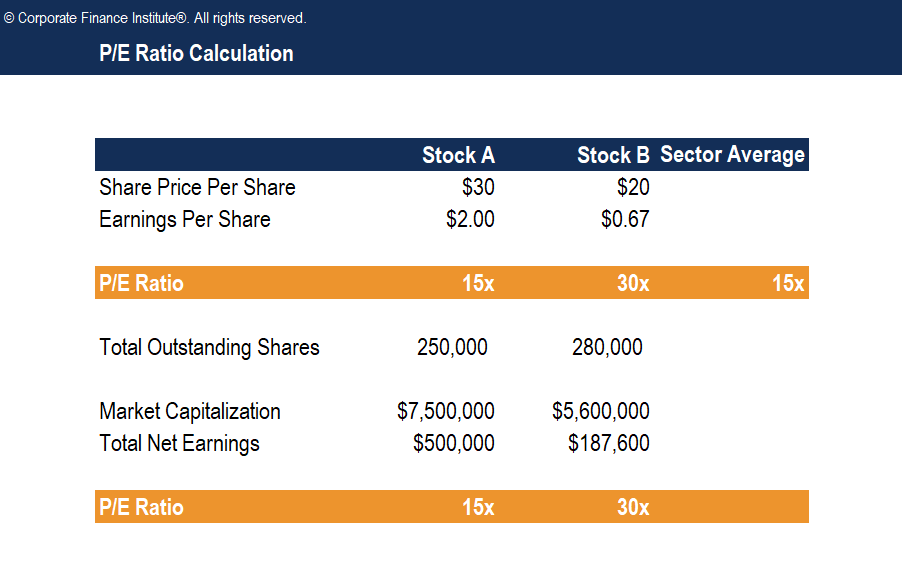
If Stock A is trading at $xxx and Stock B at $20, Stock A is not necessarily more expensive. The P/East ratio can help u.s.a. determine, from a valuation perspective, which of the two is cheaper.
If the sector's average P/E is 15, Stock A has a P/E = 15 and Stock B has a P/Due east = 30, stock A is cheaper despite having a higher absolute price than Stock B because you pay less for every $ane of current earnings. However, Stock B has a higher ratio than both its competitor and the sector. This might mean that investors will expect college earnings growth in the future relative to the market.
The P/E ratio is just one of the many valuation measures and financial analysis tools that we use to guide usa in our investment determination, and it shouldn't be the only ane.
Download the Free Template
Enter your proper name and email in the grade below and download the free template now!
P/E Ratio Template
Download the gratuitous Excel template at present to advance your finance knowledge!
Video Explanation of the Price Earnings Ratio
Below is a short video that explains how to summate a visitor'southward price-to-earnings ratio and how to interpret the results.
Video: CFI's Financial Analysis Courses .
Justified P/East Ratio
The justified P/East ratio in a higher place is calculated independently of the standard P/East. In other words, the two ratios should produce ii unlike results. If the P/E is lower than the justified P/E ratio, the company is undervalued, and purchasing the stock will issue in profits if the blastoff is closed.
Limitations of Cost Earnings Ratio
Finding the true value of a stock cannot just be calculated using current year earnings. The value depends on all expected future cash flows and earnings of a company. Cost Earnings Ratio is used as a good starting point. It ways picayune just by itself unless we accept some understanding of the growth prospects in EPS and risk profile of the company. An investor must dig deeper into the company's financial statements and utilize other valuation and financial analysis methods to get a better motion picture of a visitor'southward value and performance.
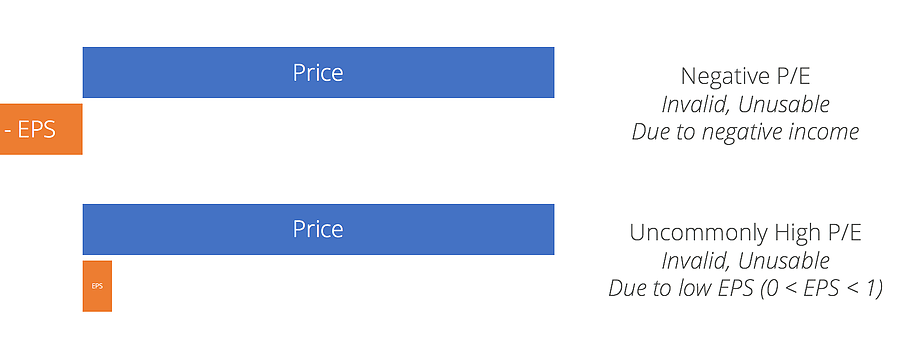
Additionally, the Price Earnings Ratio can produce wonky results, as demonstrated below. Negative EPS resulting from a loss in earnings will produce a negative P/E. An exceedingly high P/E can be generated by a company with shut to zero cyberspace income, resulting in a very low EPS in the decimals.
Additional Resources
Thank you for reading CFI's guide to Price Earnings Ratio. To go on learning and advancing your career, these boosted resources will be helpful:
- Financial Modeling Guide
- Income Statement Template
- Balance Canvas
- PEG Ratio
saundersevoichland99.blogspot.com
Source: https://corporatefinanceinstitute.com/resources/knowledge/valuation/price-earnings-ratio/
0 Response to "how to tell from p/e ratio what stock is less riskier to buy"
Post a Comment